Discworld Features
— where djinn have cellphones
Discworld has a gazillion features. As an LPMud it uses the LPC programming language which was designed specifically for MUDs. This means that while many MUDs have a very small number of coders who develop new features and a lot of builders who just script areas, all of Discworld's creators write code, which means that every room, every object, can be a little different.
In addition to using LPC, from the outset Discworld MUD has always valued features over performance. In the early days this meant that the lag was legendary. However computers have become so many orders of magnitude faster that now Discworld is exceptionally feature rich and relatively lag free.
Highlights
- Learning system
- On Discworld MUD, there isn't just the traditional MUD concept of levels. Instead, players can "learn" skills more naturally — by practicing and using them! More skilled players can teach less skilled players and gain experience points which can then be used to learn other skills and commands.
- Advanced Combat
- The combat system is every bit as sophisticated as you would expect. Players can set their tactics and perform special manoeuvres to enhance their combat. Combat groups have special commands to protect other members of the group. You can set "wimpy" points to help you escape intact from that tough fight.
- Enormous range of items
- Discworld MUD has over 500 different weapons, 350 pieces of armour, 2500 items of clothing, 500 pieces of jewellery, 1200 types of food, 600 pieces of furniture for player houses, the list goes on and on. In addition there are also many types of items that can be custom ordered.
- Varied Magic
- There are three distinct types of magic on Discworld MUD: wizard, witch and priest. Wizards see magic as a power to harness, witches view magic as a means to an end and will often use psychology instead, priests view it as a gift from their gods. In the game each of these is entirely distinct working in its own way with its own strengths and weaknesses.
- Player Run
- More and more aspects of the game are being managed and controlled by players. It started with an amazing player housing system that enables players to truly customize their homes, not through entering textual descriptions, but by interacting with objects in the game.
- Building on player houses came commercial properties. Initially player shops but then banks, money changers, gambling dens with poker, blackjack, roulette, and smithies.
- Discworld currently has two player-run newspaper completely written and edited within the game by players.
- Several guilds and cities are now player-run. The council system allows the magistrates of cities to define their own rules as to what is and is not acceptable behaviour within the city.
- Quests and Missions
- On Discworld MUD fighting and killing everything in sight is not the only pastime. The quest and mission systems on Discworld MUD are other aspects of the game. In quests and various types of missions, players collect items and use them in certain ways and/or interact with NPCs to complete specific tasks. In return, players receive experience points and often other rewards, such as money, rare items or special titles.
- Achievements
- Discworld has a system of achievements, rewards for doing something particularly well in game, for sticking to something for a long time or even just for doing something a little quirky. A player's achievements don't just offer bragging rights, but they also provide experience points and in some cases even a special title.
- Custom mudlib
- In an LPMud the mudlib is the support framework for the world. It is what defines how most common objects work and what capabilities they have.
- Because Discworld has created and maintains its own mudlib the mudlib is uniquely customized to meet the needs of Discworld. It supports Discworld specific features such as octarine (the eighth colour, the colour of magic). It also supports having snowball fights when it snows, annual special days such as beard-day and numerous other quirky and fun features.
- The Discworld mudlib also goes beyond the norm with the level of detailed interaction that is possible with objects. For example, books on Discworld can not only be read, they can be written on, they can be published and printed, you can even tear pages out of them. This kind of attention to detail, this immersive environment, is found throughout Discworld MUD.
- Sophisticated command entry
- One of the first things you will notice about Discworld is how sophisticated the command entry is. Commands such as 'put the red bottle and the green ball in the black knapsack' are commonplace. Discworld aims to make its command entry as intuitive and natural as possible.
Regions
Whereas many muds are largely made up of stock areas with a few custom ones, Discworld MUD is completely custom. The entire MUD is written to the theme of Terry Pratchett's Discworld books.
A completely custom MUD of this size and complexity is only made possible by being both long-lived and popular, or by charging. Because Discworld MUD has been running continuously since 1991 there has been much time to create many unique and interesting areas.
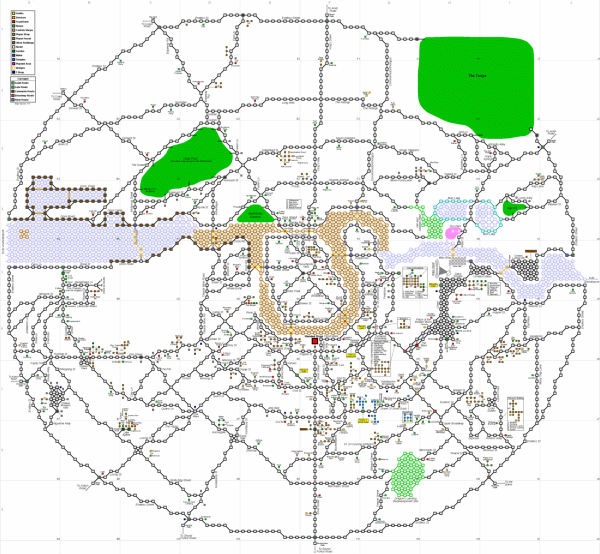
Many new visitors are shocked to find that the largest city on the MUD, Ankh-Morpork, is larger than many MUDs — and it is not the only major city or country in the game. Here is a thumbnail of Ankh-Morpork. Note that each square is a room and the green areas are parks containing many locations to explore. Blue areas (and in Ankh-Morpork's case, brown areas) represent lakes and rivers. There is an in-game mapping system which will show your immediate surroundings (based on your observation skills), but players maintain maps of cities and contintents containing much more detail. See the atlases page for more details.
In addition, through the use of terrains, all the gaps between cities and countries are being filled in with contiguous, explorable rooms featuring everything from deserts to oceans, forests to tundra.
Amazing Player Housing
Here is an example of a player house room. The room's description is generated based on what items the player placed where in the room. And yes, the clock does work, it tells the time and chimes the hours:
This is a small landing.  The ceiling is covered with lavender paint,
the floor is finished pine board and the other surfaces are covered with violet
paint.  Sitting against the south wall is a stone bench to the right of which
lies a Hershebian sand sculpture.  Near the stone bench is a chrysanthemum
stained glass fan lamp.  At the north wall is a grandmother clock.  In front of
you the bedroom door leads to a bedroom, behind you the bedroom door leads to a
bedroom and an exit leads down.
There are three obvious exits: down, backward and forward.
> look clock
Slightly smaller and slimmer than the grandfather clock, this plain
clock is made of polished white ash.  It has a narrow glass door that allows
you to see the pendulum swinging hypnotically back and forth inside.  The face
is made of ivory parchment decorated with rosebuds, and each number has been
carefully painted in gold.  Small dials indicate the date as well.
According to the clock it is quarter to eleven on Thursday the 6th of December.